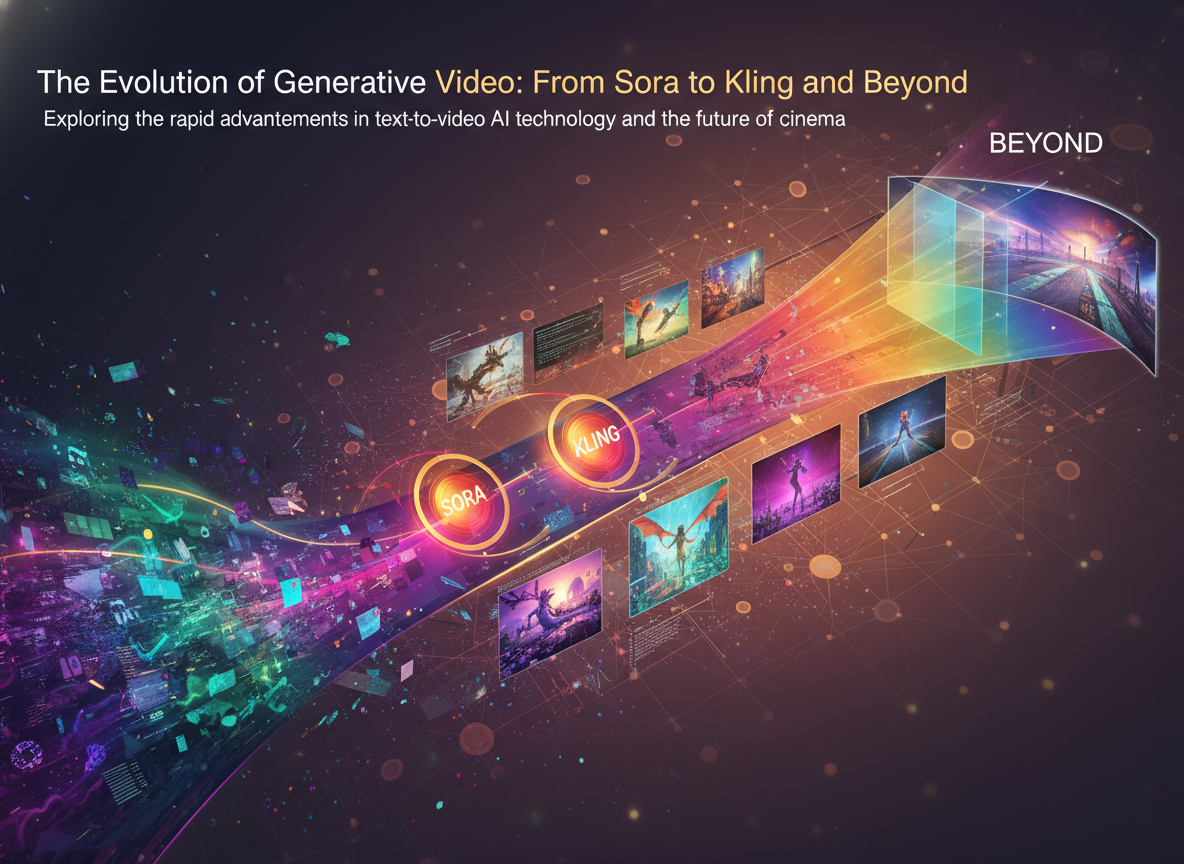
The landscape of artificial intelligence has shifted dramatically from static text and image generation toward the complex realm of high-fidelity video synthesis. This evolution, marked by the emergence of models like OpenAI's Sora and Kuaishou's Kling, represents a monumental leap in how machines understand temporal consistency and physical dynamics. Just a few years ago, AI-generated video was characterized by jittery, surrealist loops that barely resembled reality, yet today we are witnessing cinematic-quality clips that challenge our perception of what is real and what is synthetic.
OpenAI's Sora set a high benchmark earlier this year by demonstrating the ability to generate minute-long videos with intricate camera movements and multi-character interactions. By utilizing a diffusion-transformer architecture, Sora treats video data as patches of spacetime, allowing it to maintain an unprecedented level of continuity. This technical shift from standard convolutional neural networks to transformer-based diffusion models has become the blueprint for subsequent competitors aiming to master the art of motion.
In the months following Sora's announcement, international competitors like Kling have emerged, offering similar capabilities with impressive realism and physical simulation. Kling, developed by Chinese tech giant Kuaishou, has gained significant traction for its ability to handle complex human movements, such as eating or walking, which have traditionally been difficult for generative models to replicate without artifacts. This global competition is accelerating the development cycle, pushing the boundaries of frame rate, resolution, and motion accuracy.
Beyond simple aesthetics, the underlying physics engines of these models are becoming increasingly sophisticated. Modern generative video models are not just predicting the next pixel; they are learning latent representations of physical laws, such as gravity, fluid dynamics, and lighting. When a character in an AI video pours water into a glass, the model must understand the transparency of the liquid, the refraction of light, and the way the glass fills, highlighting a deep, learned understanding of the physical world.
The implications for the creative industries are profound and multifaceted. Filmmakers, advertisers, and content creators are beginning to view AI as a powerful tool for pre-visualization and asset generation. Instead of spending weeks on expensive location scouting or complex CGI rendering, creators can now prototype scenes in minutes. This democratization of high-end visual effects could lower the barrier to entry for independent creators while forcing major studios to rethink their production workflows.
However, this rapid advancement brings significant ethical and security concerns, particularly regarding deepfakes and misinformation. As the 'uncanny valley' closes, the potential for malicious actors to create convincing fake footage increases. This has led to a call for robust digital watermarking standards and provenance tracking, such as the C2PA protocol. Tech companies are now under immense pressure to balance open innovation with the responsibility of preventing the spread of synthetic disinformation.
Technical scaling remains a central theme in the progression of generative video. Developers are moving toward larger datasets and more compute-intensive training runs to improve the duration and coherence of generated clips. The goal is to move from 60-second snippets to full-length narrative structures, which requires the AI to maintain 'memory' of characters and environments over extended periods. Achieving long-range temporal consistency is the next great hurdle for the industry.
In conclusion, we are entering a new era of digital expression where the line between the physical and the virtual is increasingly blurred. As generative video models become more accessible and capable, they will transform not only how stories are told but how we perceive visual media itself. The next decade promises a revolution in entertainment and communication, powered by the intricate synthesis of pixels and artificial intelligence.