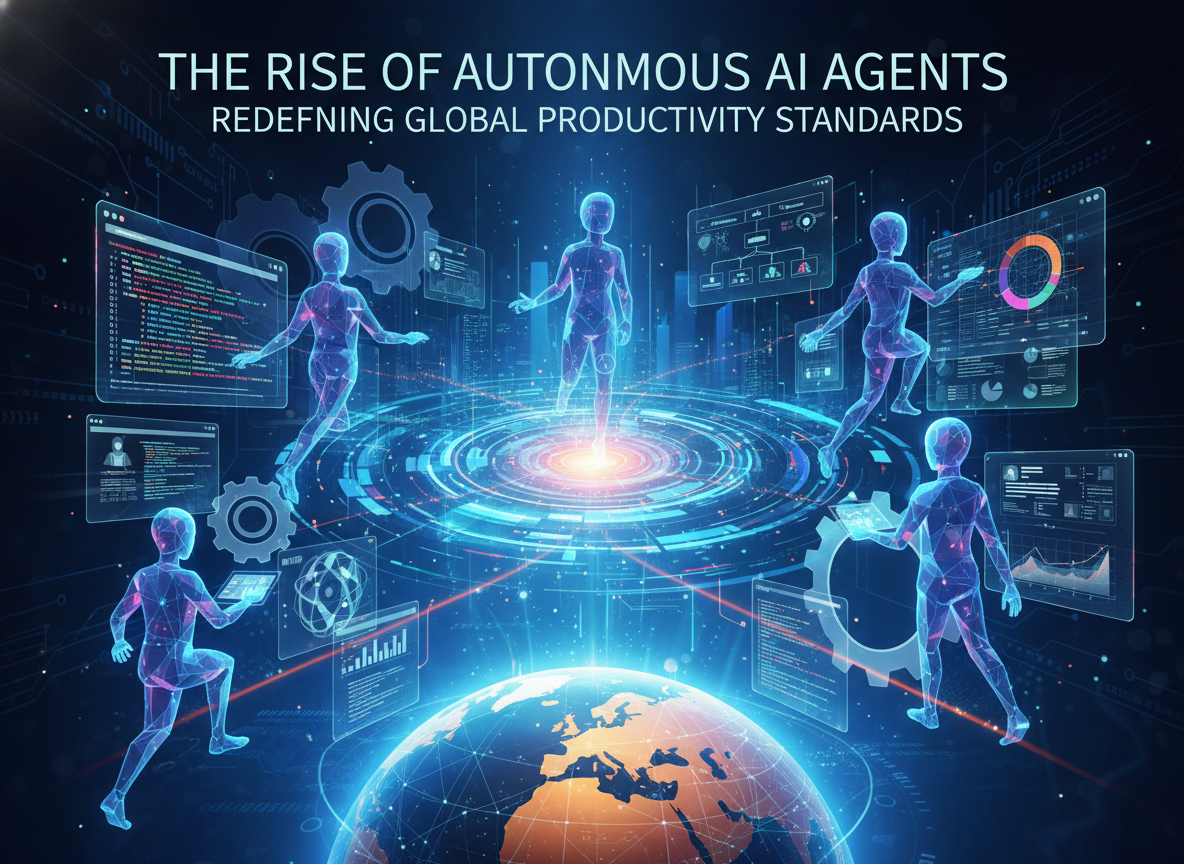
The landscape of artificial intelligence is undergoing a seismic shift as the industry transitions from passive large language models to proactive autonomous agents. Unlike traditional chatbots that require constant prompting and human oversight, these new systems are designed to perceive their environment, reason through complex multi-step goals, and execute tasks with minimal intervention. This evolution marks a critical turning point where AI stops being a digital assistant and starts functioning as a digital colleague capable of independent thought and action.
At the forefront of this movement is Devin, the world's first AI software engineer developed by Cognition Labs. Devin represents a massive leap forward by demonstrating the ability to handle entire coding projects from start to finish, including debugging, deployment, and learning new technologies on the fly. By integrating a browser, a code editor, and a terminal into its operating environment, Devin can research documentation and implement solutions just as a human developer would, signaling a new era for the software development life cycle.
The technical architecture enabling these agents relies on advanced recursive loops and chain-of-thought reasoning. By breaking down high-level objectives into smaller, manageable sub-tasks, agents can evaluate their own progress and adjust their strategies in real-time. This self-correcting nature is what separates agents from standard LLMs, as they can identify when a specific path is failing and pivot to an alternative solution without human prompting, thereby reducing the friction historically associated with automated systems.
Open-source projects like AutoGPT and BabyAGI paved the way for this revolution, but the commercialization of these technologies is where the real impact is being felt across industries. From automated market research to complex financial modeling, companies are beginning to deploy agentic frameworks to handle high-volume, logic-heavy workflows. The integration of these tools into existing enterprise resource planning systems allows for a level of operational efficiency that was previously thought to be decades away.
However, the rise of autonomous agents brings about significant discussions regarding the future of the labor market and the necessity of human-in-the-loop oversight. As agents take over routine and even semi-complex tasks, the role of the human worker shifts toward high-level strategy and ethical gatekeeping. This transition requires a fundamental reevaluation of educational curricula and professional training programs to ensure that the workforce is prepared to collaborate with increasingly capable machine counterparts.
Security and safety also remain paramount concerns as we grant AI agents the authority to interact with real-world APIs and sensitive data. The potential for 'hallucination-driven actions'—where an agent takes an incorrect action based on a false logical premise—requires robust sandboxing and verification protocols. Developing 'guardrail' technologies that can monitor agent behavior in real-time is becoming a booming sub-sector within the AI safety industry, attracting significant venture capital investment.
The scalability of these agents is another factor driving high traffic and interest among tech leaders. Because digital agents can be cloned and deployed across massive cloud infrastructures, they offer a horizontal scaling capability that human teams simply cannot match. For startups, this means the ability to achieve enterprise-level output with a fraction of the traditional headcount, potentially leading to a new wave of 'unicorn' companies driven by lean, AI-augmented teams.
Looking forward, the next phase of agent development involves multi-agent orchestration, where different specialized AI agents communicate and collaborate with each other to solve even larger problems. Imagine a marketing agent, a data analysis agent, and a creative design agent working in a unified swarm to launch a global campaign. This interconnected ecosystem of intelligence will likely be the cornerstone of the next decade's technological progress, cementing autonomous agents as the most transformative tool of the modern era.