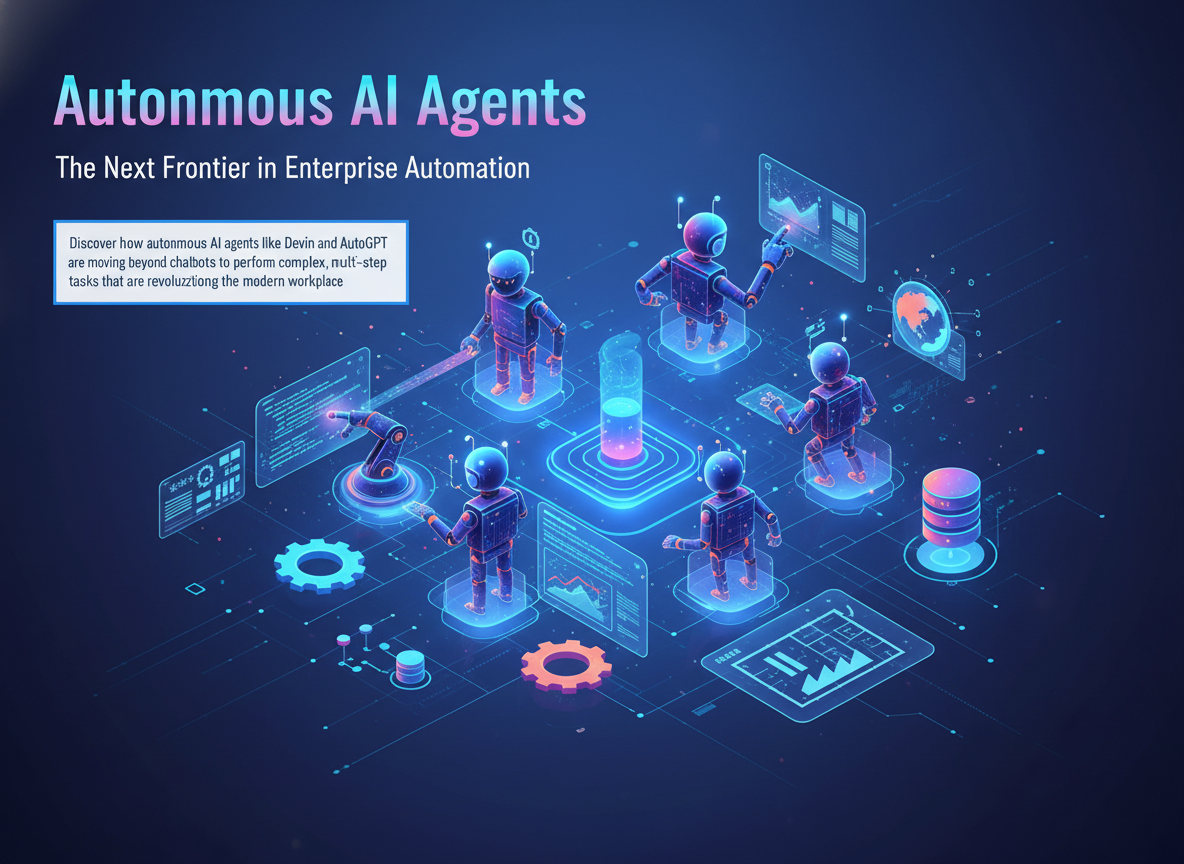
The narrative of artificial intelligence is rapidly shifting from passive conversational interfaces to active autonomous agents capable of independent reasoning and task execution. These agents, powered by Large Action Models (LAMs), are designed to interact with external software, browse the web, and execute complex workflows without constant human oversight. Unlike traditional chatbots that provide information, autonomous agents can perform actions, such as writing and debugging code, managing projects, or coordinating logistics. This transition marks the beginning of a new era in productivity where AI becomes a functional member of the workforce.
A standout example of this trend is Devin, often hailed as the world’s first AI software engineer, which can handle entire development projects from conception to deployment. Devin is capable of navigating complex codebases, learning new technologies on the fly, and fixing bugs autonomously by simulating a human developer’s thought process. This level of autonomy is achieved through advanced planning modules and a feedback loop that allows the agent to learn from its errors during the execution phase. The success of such agents demonstrates that AI is no longer just an assistant but a proactive problem-solver.
The architecture of autonomous agents involves several key components, including long-term memory, planning capabilities, and the ability to use tools. By leveraging vector databases, agents can recall past interactions and information, allowing them to maintain context over long-term projects. Planning modules break down complex goals into manageable sub-tasks, which the agent then executes using a variety of APIs and digital tools. This modular approach allows for a high degree of flexibility, enabling agents to operate across diverse domains ranging from finance to creative design.
In the enterprise sector, the integration of autonomous agents is expected to drive massive efficiency gains by automating repetitive and cognitively demanding tasks. Organizations are exploring 'multi-agent systems' where different AI agents collaborate with each other to solve multifaceted business problems. For example, a marketing agent might create a campaign strategy, while a creative agent generates the visual assets and a data agent monitors the performance in real-time. This orchestration of specialized AI entities allows human workers to focus on high-level strategy and creative vision rather than operational minutiae.
However, the move toward autonomy introduces significant challenges regarding reliability, security, and accountability. As agents gain the ability to make decisions and execute actions in real-world environments, the risk of unforeseen errors or unintended consequences increases. Ensuring that these agents operate within ethical boundaries and comply with organizational policies is a major focus for developers. Robust 'human-in-the-loop' systems are currently being designed to provide oversight and intervention capabilities, ensuring that humans remain the ultimate decision-makers in critical scenarios.
The competitive landscape for AI agents is expanding rapidly, with major cloud providers and startups vying for dominance. Companies like Microsoft, through its Copilot Studio, and Salesforce, with its Agentforce platform, are providing tools for businesses to build and customize their own autonomous agents. The goal is to create a seamless ecosystem where AI can navigate through different software applications as easily as a human does. This competition is accelerating the pace of innovation, leading to more refined and capable agentic frameworks every month.
Predicting the trajectory of this technology, we can anticipate a future where AI agents become ubiquitous in our personal and professional lives. We may soon have personal agents that manage our schedules, negotiate bills, and even handle complex travel arrangements with minimal input. In the workplace, the roles of employees will evolve to become 'agent orchestrators,' responsible for managing fleets of AI agents to achieve business objectives. This shift will require a new set of skills centered on AI management, prompt engineering, and ethical oversight.
Ultimately, autonomous AI agents represent the next logical step in the evolution of computing. By moving from a tool-centric approach to a task-centric approach, they are fundamentally changing the way we interact with technology. While the transition will require careful management and new regulatory frameworks, the potential to unlock unprecedented levels of human potential is immense. As these agents become more sophisticated and reliable, they will undoubtedly become the backbone of the global digital economy.