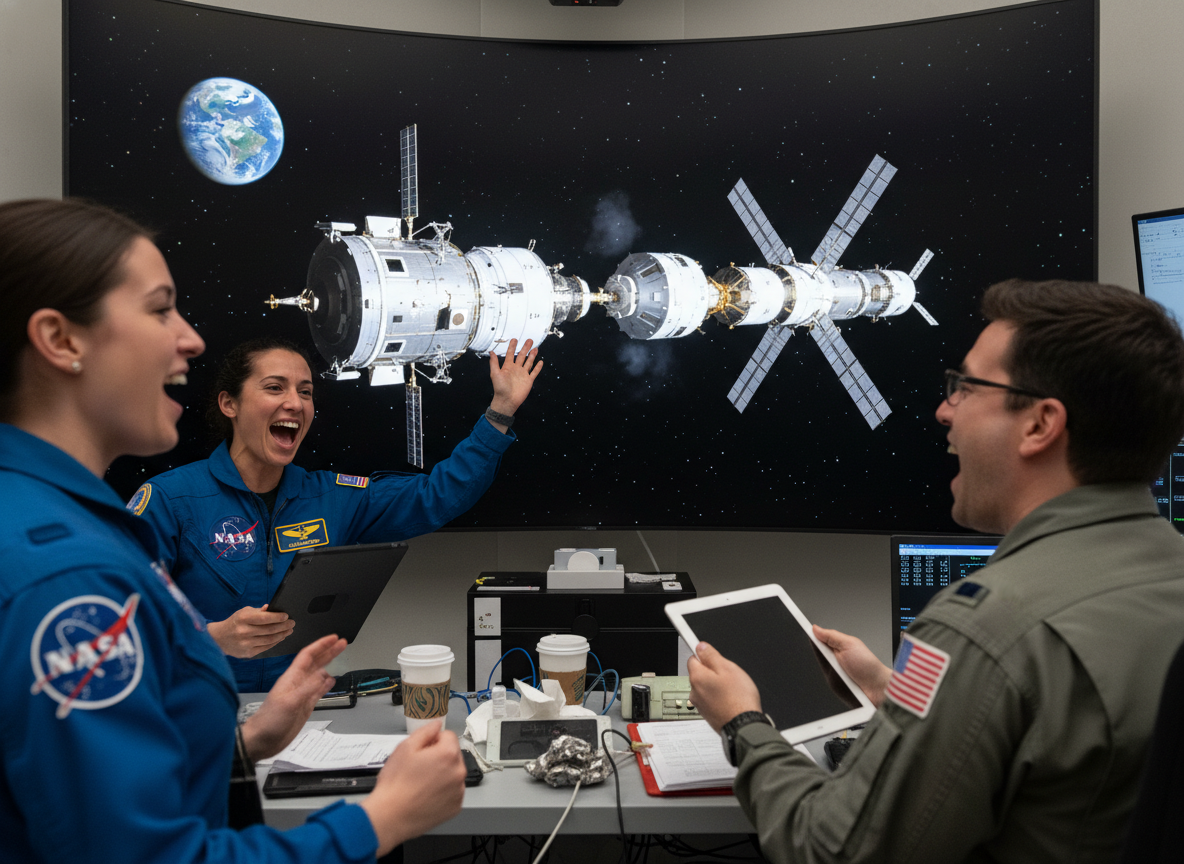
In the early hours of April 7, 2026, mission control centers in Houston and Munich erupted in cheers as the Habitation and Logistics Outpost (HALO) successfully docked with the Lunar Gateway's Power and Propulsion Element (PPE). This critical maneuver marks the official establishment of the first permanent human-inhabited station in orbit around the Moon. The docking sequence, which took nearly six hours of precision navigation, was executed autonomously under the watchful eyes of ground controllers and the crew of the nearby Orion spacecraft. This achievement is a cornerstone of the Artemis III mission, paving the way for sustained human presence on the lunar surface.
The HALO module, developed by Northrop Grumman in collaboration with the European Space Agency (ESA), serves as the primary living quarters and command center for astronauts visiting the Gateway. It features state-of-the-art life support systems, radiation shielding, and docking ports for visiting vehicles like SpaceX's Starship and the Orion capsule. Today's success ensures that future missions will have a reliable 'waystation' where crews can prepare for descent to the lunar south pole. The modular nature of the Gateway allows for future expansions, with Japan and Canada already preparing their own scientific modules for launch later this year.
Scientific objectives for the Gateway are as ambitious as the engineering required to build it. Once fully operational, the station will serve as a laboratory for deep-space biology, heliophysics, and lunar geology. Researchers plan to use the Gateway's unique position outside Earth’s protective magnetosphere to study the long-term effects of cosmic radiation on biological tissue, a prerequisite for any future crewed missions to Mars. Additionally, the station will deploy autonomous rovers to the lunar surface to scout for water ice in permanently shadowed craters, a resource vital for producing rocket fuel and oxygen.
The geopolitical implications of today's docking cannot be overstated. The Artemis Accords, now signed by over 45 nations, emphasize international cooperation and the peaceful use of outer space. By successfully integrating hardware from multiple countries, NASA has demonstrated that complex space infrastructure can be built through global partnership. This stands in contrast to the more isolated space programs of the past, signaling a new era of collaborative exploration. The presence of ESA astronauts on this mission further solidifies the bond between transatlantic space agencies and sets a precedent for shared lunar governance.
Technically, the docking was a masterclass in modern aerospace engineering. The Gateway orbits the Moon in a 'Near-Rectilinear Halo Orbit' (NRHO), a highly stable path that provides constant communication with Earth while requiring minimal fuel for station-keeping. The HALO module utilized advanced lidar sensors and computer vision algorithms to align itself with the PPE with a margin of error of less than two centimeters. This level of precision is necessary because the Gateway must withstand the extreme gravitational pulls of both the Earth and the Moon simultaneously. Today's flawless execution proves that our navigation technology is ready for the rigors of deep space.
Public engagement with the Artemis program has reached a fever pitch, with millions of people worldwide tuning into the live 4K stream of the docking. Educational programs in schools have integrated the mission into their STEM curricula, inspiring a new generation of scientists and explorers. The 'Artemis Generation' now sees a future where living and working in space is a reality rather than science fiction. NASA's strategic communication efforts, including interactive VR experiences of the HALO module, have played a significant role in maintaining public support for the multi-billion dollar program.
Despite the celebration, the mission is not without its risks. The crew of Artemis III must now begin the complex process of pressurizing the HALO module and conducting a series of 'internal spacewalks' to finalize the wiring and life support systems. Any malfunction in this high-vacuum, high-radiation environment could be catastrophic. However, the mission's lead flight director expressed complete confidence in the hardware and the rigorous training the astronauts have undergone. The next 48 hours will be critical as the team transitions from the Orion capsule to the Gateway for the first time.
Looking ahead, the success of the Lunar Gateway serves as a vital stepping stone for the 'Moon to Mars' initiative. By learning how to sustain life in a deep-space environment far from Earth's immediate help, NASA and its partners are building the expertise needed for the multi-year journey to the Red Planet. Today’s docking is more than just a piece of metal joining another; it is the foundation of a new home for humanity among the stars. As the Gateway orbits the Moon every seven days, it will stand as a bright, visible reminder of what can be achieved when global resources are focused on a singular, noble vision.