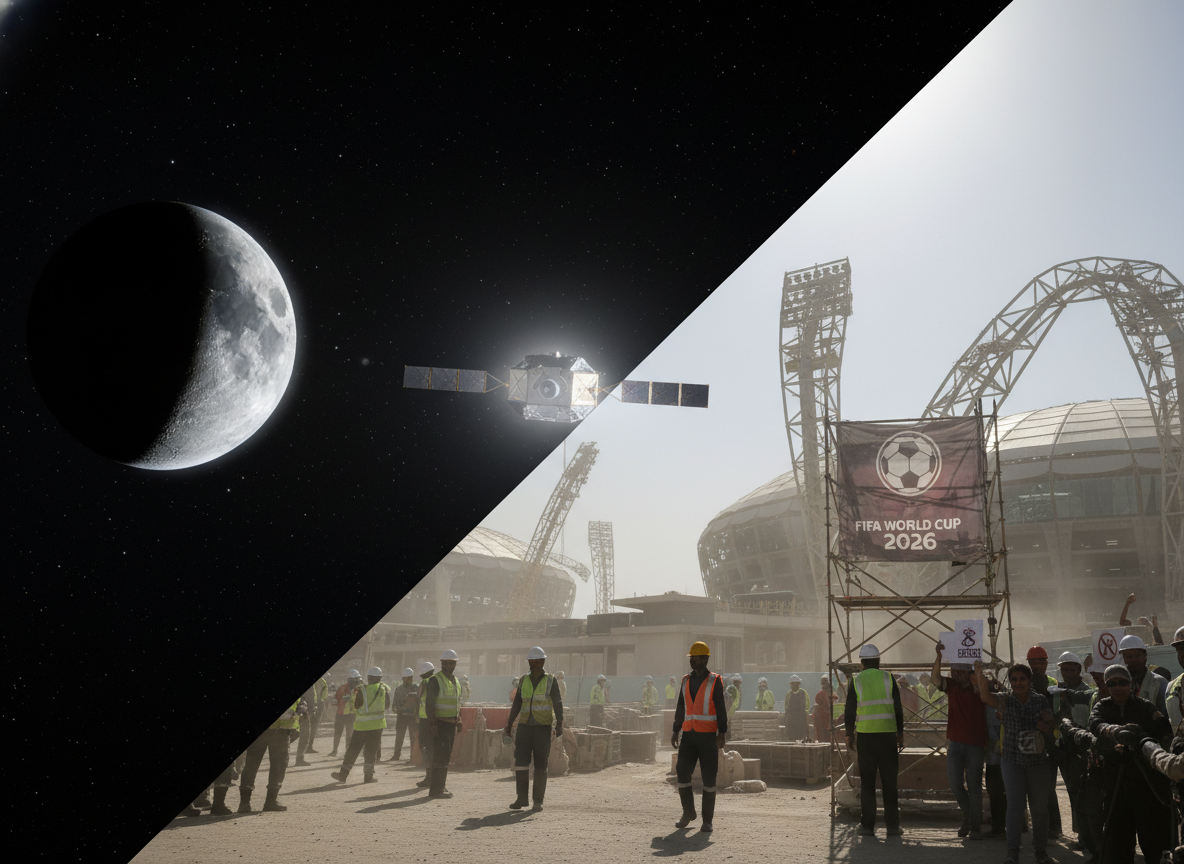
In a historic morning for human spaceflight, the Orion spacecraft carrying the Artemis II crew has officially passed the halfway point between Earth and the Moon today, April 5, 2026. NASA confirmed that the four-person crew—Commander Reid Wiseman, Pilot Victor Glover, and Mission Specialists Christina Koch and Jeremy Hansen—are in excellent spirits and that all life-support systems are performing above expectations. This mission, which launched from Kennedy Space Center on April 1, marks the first time humans have ventured this far into deep space since the end of the Apollo era in 1972. The craft is currently navigating its planned hybrid free-return trajectory, a critical phase that will use lunar gravity to slingshot the astronauts back toward Earth after a brief but historic flyby of the lunar far side.
While the technical success of Artemis II provides a much-needed sense of global achievement, it comes at a time of significant transition for the American space program. Only last month, NASA made the controversial decision to officially cancel the Lunar Gateway space station project, a move that shifted the program's immediate focus toward direct surface landings and long-term lunar base construction. This strategic pivot has redefined the upcoming Artemis III mission, now slated for 2027 as a Low Earth Orbit demonstration rather than a lunar landing. As the Orion capsule drifts further from its home planet today, the mission serves as a vital bridge between the theoretical planning of the last decade and the practical reality of becoming a multi-planetary species.
On the terrestrial front, the celebratory mood of Easter Sunday is being tempered by volatile global markets and escalating geopolitical friction. Brent crude oil prices have surged to a three-year high of $120 per barrel following continued disruptions in the Strait of Hormuz. Economic analysts warn that the ongoing conflict in the Middle East is creating a 'COVID-scale' contraction risk, as supply chains for critical materials like helium and semiconductors remain under extreme pressure. The International Monetary Fund (IMF) released a revised forecast earlier this week, projecting global growth at a cautious 3.1 percent for 2026, citing the 'jobless growth' phenomenon driven by the rapid, widespread integration of generative AI into corporate infrastructures.
The shadow of international conflict has also extended into the world of sports, specifically targeting the 2026 FIFA World Cup. In a press briefing late yesterday, President Donald Trump reiterated his stance that the Iranian national team's participation in matches hosted on U.S. soil remains a security concern, suggesting that the team might be better suited playing their matches in Mexico for 'their own safety.' Despite this political pressure, FIFA issued a firm statement this morning reaffirming that there are no plans to alter the official match schedule. A spokesperson for the governing body emphasized that the tournament, set to kick off on June 11, will proceed as a unified event across Canada, Mexico, and the United States, featuring the first-ever 48-team format in World Cup history.
Football fans around the world are nonetheless undeterred by the headlines, as the 'last-minute' ticket sales phase, which opened on April 1, has seen unprecedented demand. With Mexico City set to host the inaugural match between Mexico and South Africa at the legendary Estadio Azteca, the logistical scale of the 2026 tournament is becoming apparent. However, the intersection of sports and politics remains a delicate balancing act. While local organizing committees in cities like New York and Vancouver are focusing on infrastructure and fan zones, the White House’s 'Salute to America 250' task force is coordinating its own series of cultural events that overlap with the World Cup schedule, leading to complex security and diplomatic arrangements for visiting foreign dignitaries.
In addition to the lunar mission and sports drama, today marks the conclusion of the ITTF World Cup in Macao, where the world's elite table tennis players have been competing in a revamped 48-player format. Simultaneously, the ISSF World Cup in Granada, Spain, officially opens today, with Olympic hopefuls from over 50 nations arriving to compete in rifle and pistol events. These sporting milestones provide a brief respite from the heavier news cycle, showcasing human excellence and international cooperation even as diplomatic channels between major powers remain strained over trade tariffs and the ongoing 'round two' of the new global trade order.
Astronomically, April 2026 is proving to be a rare month for skywatchers. Following yesterday’s perihelion of Comet C/2026 A1 (MAPS), which many observers reported seeing as a faint but distinct smudge in the pre-dawn sky, veteran astronomers are now looking forward to the Lyrid meteor shower later this month. Tonight, under the light of the waning Pink Moon, those with telescopes are also tracking Mercury as it reaches its greatest eastern elongation. These celestial events provide a poignant backdrop to the Artemis II mission, reminding the public of the vast, indifferent beauty of the universe as four human beings prepare to witness the Earth rising over the lunar horizon in the coming days.
As the world observes Easter Sunday 2026, the contrast between human progress and earthly challenges has rarely been more striking. From the high-tech confines of the Orion capsule to the tense negotiations in the corridors of power in Washington and Tehran, the events of April 5 reflect a planet in a state of rapid evolution. Whether it is the pursuit of the lunar frontier or the struggle to maintain peace during a global sporting event, the current moment highlights the resilience and ambition of the human spirit. As we look toward the remainder of 2026, the success of the Artemis II mission remains a beacon of hope—a reminder that despite our divisions, the reach for the stars remains a universal endeavor.