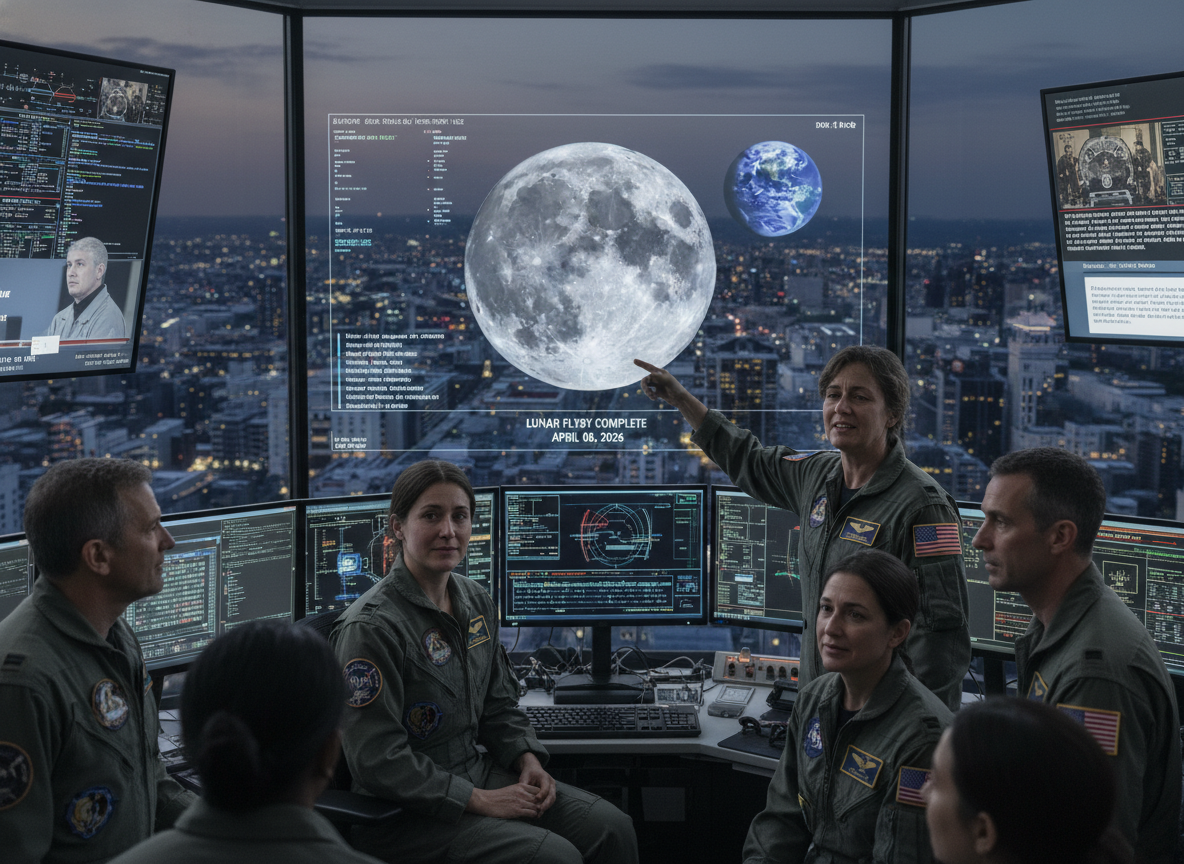
Today marks a watershed moment for human spaceflight and the future of lunar exploration. As of 12:41 AM EDT on April 6, 2026, the NASA Artemis II Orion spacecraft officially entered the Moon’s sphere of influence, setting the stage for the first human-crewed lunar flyby in more than half a century. The mission, which launched from Kennedy Space Center on April 1, represents the culmination of decades of international collaboration and a fundamental shift in how humanity views its celestial neighbor. As the four-person crew prepares for their closest approach to the lunar surface today, the world watches with bated breath, witnessing a revival of the pioneering spirit that first brought humanity to the Moon in 1969.
The crew of Artemis II, consisting of Commander Reid Wiseman, Pilot Victor Glover, Mission Specialist Christina Koch, and CSA Mission Specialist Jeremy Hansen, has spent the last five days conducting rigorous checks of the Orion’s complex life support and navigation systems. Despite minor technical challenges earlier in the flight—including a publicized concern regarding the spacecraft's waste management system—the crew remains in high spirits and optimal health. Mission Control in Houston confirmed that the astronauts have already begun their seven-hour intensive observation window, targeting 35 specific lunar sites for high-resolution photography and spectral analysis. These observations are critical for mapping potential landing zones for the upcoming Artemis III mission.
While the lunar flyby dominates headlines, the technological environment of 2026 is vastly more sophisticated than that of the Apollo era. This mission relies heavily on AI-driven autonomous navigation and real-time data compression techniques recently perfected by institutions like Caltech. These breakthroughs have allowed the Orion to transmit massive datasets and high-definition video back to Earth with minimal latency, even through the interference of deep space. The integration of 1-bit large language models for onboard diagnostic assistance has significantly reduced the computational load on the spacecraft’s hardware, ensuring that the crew has access to rapid, reliable problem-solving tools without the need for massive server banks on board.
However, the triumph of Artemis II occurs against a backdrop of severe global instability and shifting geopolitical alignments. The ongoing conflict in the Middle East has entered a critical phase, with April 6 seeing intensified military operations and diplomatic maneuvering. Early this morning, international reports confirmed the successful rescue of a second U.S. airman in Iran after their F-15E Strike Eagle was downed earlier this month. The high-stakes extraction by U.S. special forces highlights the volatility of the region, where a 37-day campaign has disrupted global markets and led to repeated drone strikes on critical petroleum and data infrastructure in Kuwait, Bahrain, and the United Arab Emirates.
The geopolitical tension has forced a dramatic restructuring of global energy and economic policies. In a significant move today, OPEC+ announced a planned increase in oil output by 206,000 barrels per day starting in May to mitigate the supply shocks caused by the closure of the Strait of Hormuz. Markets have reacted with extreme volatility, with oil prices climbing as investors weigh the potential for a wider regional escalation. This energy crisis has accelerated the global push for alternative power solutions, such as the recently unveiled quantum battery prototypes from RMIT University, which promise near-instant charging and scalable storage that could eventually decouple global transport from fossil fuel reliance.
On the political front, the United States is navigating a period of internal transition and administrative reshuffling. Within the last 24 hours, the administration has undergone a major leadership purge, including the dismissal of the U.S. Army Chief of Staff and the Attorney General. These shifts, occurring amidst the high-intensity 'Operation Epic Fury,' have drawn both domestic scrutiny and international concern regarding the stability of U..S. foreign policy. The administration’s focus on upcoming national infrastructure celebrations, slated for later this week, underscores a pivot toward domestic resilience even as the conflict in West Asia continues to strain conventional military resources and long-standing international alliances.
Scientific communities are simultaneously buzzing with the news of a revolutionary quantum computing design proposed by Caltech and the startup Oratomic. By slashing the hardware requirements for fault-tolerant quantum computers by nearly 100-fold, researchers suggest that the era of unbreakable encryption and complex molecular simulation is much closer than previously anticipated. This breakthrough, combined with the successful testing of room-temperature quantum batteries, suggests that by the end of 2026, the fundamental ways in which humanity processes information and stores power will have undergone a paradigm shift, potentially solving some of the very resource conflicts currently plaguing the globe.
As Artemis II prepares for its eventual splashdown in the Pacific Ocean on April 10, the mission serves as a dual symbol of progress and a reminder of the challenges ahead. The data gathered during today’s lunar flyby will be instrumental for the Artemis III landing mission scheduled for next year, which aims to place the first woman and the first person of color on the lunar surface. For now, the successful flyby offers a brief moment of global unity. In a world currently fractured by conflict and economic uncertainty, the sight of the Orion capsule silhouetted against the cratered lunar horizon reminds us of our species' capacity for greatness when we aim beyond our terrestrial boundaries.