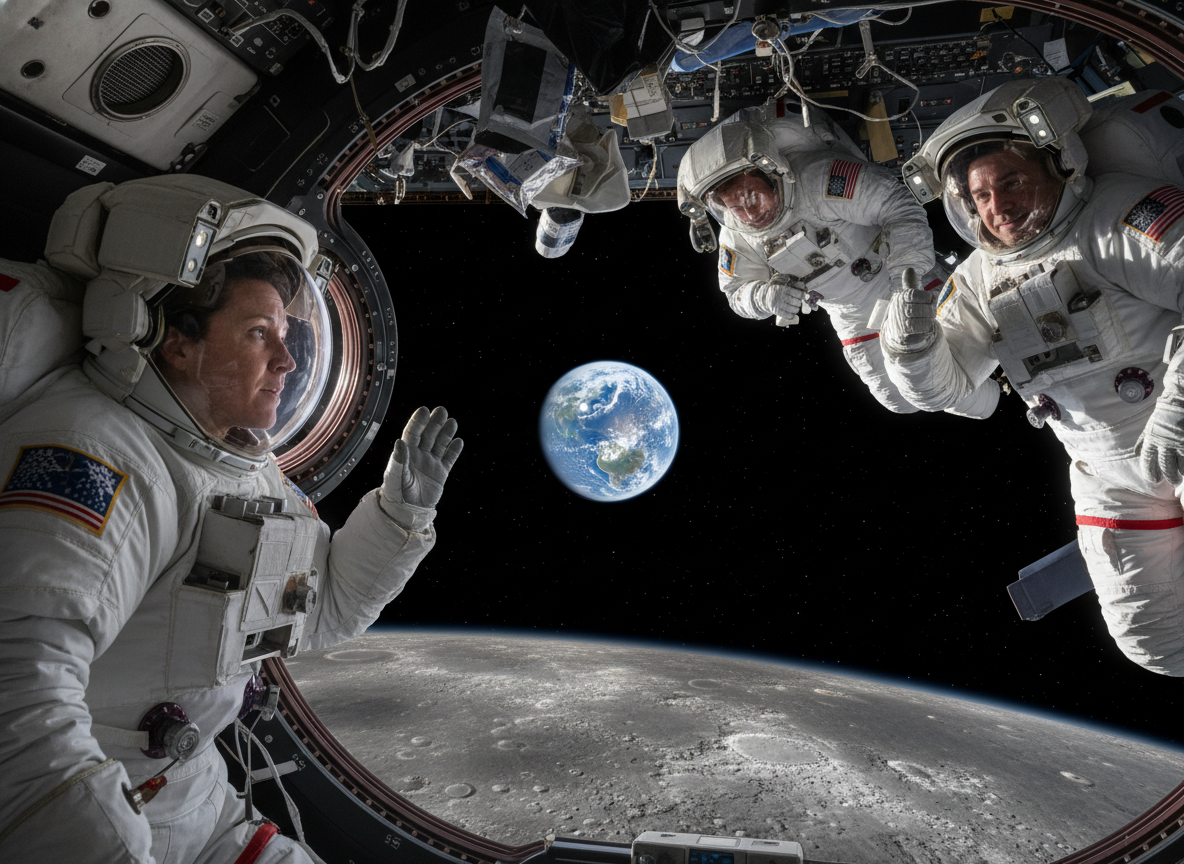
Humanity has officially entered a new era of deep-space exploration. On Tuesday, April 7, 2026, the four-person crew of NASA’s Artemis II mission began their high-speed transit back to Earth after completing a historic flyby of the Moon. This mission marks the first time humans have ventured to the lunar vicinity in over half a century, successfully testing the Orion spacecraft's life-support systems and the Space Launch System’s (SLS) deep-space capabilities. The crew, consisting of NASA astronauts Reid Wiseman, Victor Glover, Christina Koch, and CSA astronaut Jeremy Hansen, has spent the last 24 hours navigating the most critical phase of their 10-day journey.
The mission reached its most celebrated milestone late yesterday, April 6, when the Orion capsule surpassed the record for the farthest human spaceflight from Earth. Traveling to a staggering distance of 252,756 miles (406,769 kilometers) from our home planet, the Artemis II crew exceeded the previous record set by the legendary Apollo 13 mission in 1970 by more than 4,000 miles. This achievement was not merely a numerical victory but a symbolic statement that the constraints of the 20th-century space race have finally been broken, paving the way for sustained lunar presence and eventual Mars missions.
During the closest approach to the lunar surface—approximately 4,067 miles above the cratered landscape—the astronauts provided emotional live commentary that captivated a global audience. Canadian astronaut Jeremy Hansen described the view as 'mind-blowing,' noting that the details visible to the naked eye far exceeded any high-resolution imagery previously captured by robotic probes. The crew spent several hours conducting intensive lunar observations, focusing on the Reiner Gamma swirl and the Glushko crater, areas earmarked for future robotic and crewed landings under the Artemis program.
A particularly breathtaking moment occurred when the Orion spacecraft entered a planned solar eclipse period. For approximately 54 minutes, the Moon completely obscured the Sun from the crew's perspective, allowing them to witness the solar corona with a clarity never before experienced by human eyes. This unique vantage point provided invaluable data for solar physicists back on Earth, while Victor Glover shared a poignant message with Mission Control in Houston, describing the sight of a crescent Earth rising over the lunar horizon as a 'photo of all of humanity' in a single frame.
As of 1:23 p.m. EDT on April 7, the Orion spacecraft officially exited the lunar sphere of influence. This technical transition signifies that the Moon's gravity is no longer the primary force acting on the vehicle, as Earth’s gravitational pull takes over to guide the crew home. To ensure a precise landing, the crew is currently monitoring a series of return trajectory correction burns. These maneuvers are vital for refining the capsule's path toward the narrow atmospheric entry corridor required for a safe return to the Pacific Ocean.
The success of the Artemis II flyby is viewed by experts as the definitive proof-of-concept for the upcoming Artemis III landing mission. By proving that the Orion spacecraft can safely house and protect a crew in the high-radiation environment beyond Earth’s magnetosphere for extended periods, NASA has cleared the primary hurdle for the first lunar landing of the 21st century. The data collected during this mission regarding cabin pressure, radiation shielding, and internal communications will be used to finalize the hardware for the next phase of lunar colonization.
Global engagement with the mission has reached levels not seen since the original Moon landings. NASA reported that its live streams and 'Earthrise' social media updates have garnered billions of impressions, highlighting a renewed international interest in space as a unifying frontier. Schools and universities across the globe have integrated the flight data into real-time curriculum, and the 'Artemis Generation' is already looking toward the establishment of the Gateway station and the first permanent Moon Base scheduled for later this decade.
The mission is now in its final stretch, with a planned splashdown off the coast of San Diego on Friday, April 10, at approximately 5:07 p.m. PDT. Recovery teams from the U.S. Navy and NASA are already in position in the Pacific, preparing for the high-stakes re-entry where Orion will hit the atmosphere at speeds exceeding 25,000 miles per hour. As the world awaits the safe return of Wiseman, Glover, Koch, and Hansen, the legacy of Artemis II is already secure: they have gone farther than any human before them, and they have brought the Moon within our reach once again.