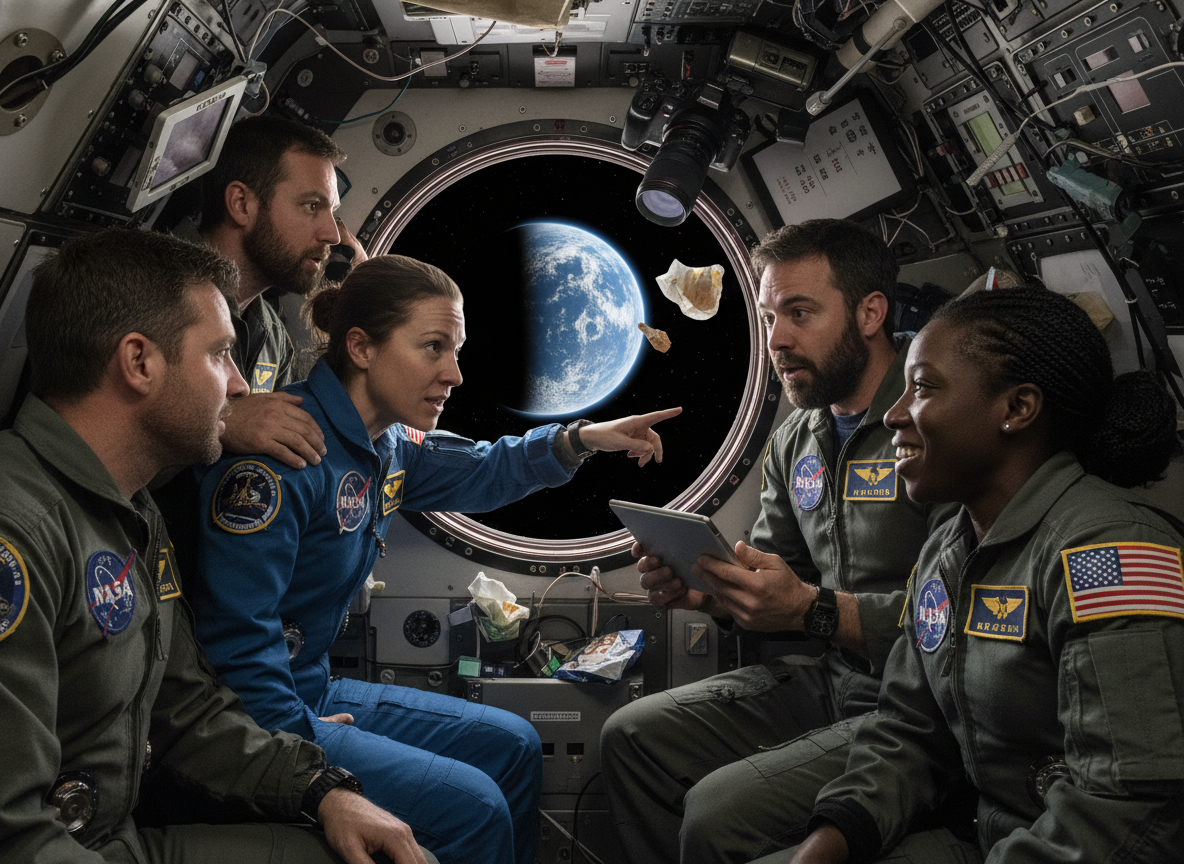
In a historic milestone for space exploration, the four-person crew of the Artemis II mission officially entered the Moon's 'sphere of influence' early this morning, Monday, April 6, 2026. At approximately 12:37 a.m. EDT, the Orion spacecraft crossed the invisible threshold where lunar gravity becomes the dominant force acting upon the vessel, marking the first time humans have achieved this feat since the Apollo 17 mission in 1972. The crew, consisting of Reid Wiseman, Victor Glover, Christina Koch, and Jeremy Hansen, spent the early hours of the day preparing for a series of complex lunar observations.
The highlight of today's flight was the breaking of the all-time human distance record from Earth. By mid-afternoon, Orion surpassed the 400,171-kilometer record set by the ill-fated Apollo 13 mission in 1970. NASA flight directors in Houston confirmed that at its maximum distance during the lunar flyby, the Artemis II crew reached an unprecedented 406,773 kilometers from their home planet. This achievement is not merely symbolic; it represents the first successful test of the Orion capsule's deep-space life-support systems under the intense radiation environments of the far side of the Moon.
As the spacecraft passed behind the Moon, the crew experienced a planned communications blackout lasting approximately 40 minutes. During this period of isolation, the astronauts focused on capturing high-resolution imagery of the lunar far side, particularly the Orientale basin. This 3.8-billion-year-old impact crater was fully illuminated during the pass, providing the crew with a perspective never before seen by human eyes. Canadian astronaut Jeremy Hansen remarked via a pre-recorded transmission that the lunar surface appeared as vivid and textured as 'a basketball held at arm's length.'
One of the most anticipated moments of the flyby was the planned 'Earthrise' photograph. Unlike the spontaneous image captured by the Apollo 8 crew, today's event was meticulously choreographed by NASA visualization specialists. Using digital SLR technology far more advanced than the analog cameras of the 1960s, the crew captured a series of stunning 8K images of the blue marble rising over the lunar horizon. These images are expected to be downlinked to Earth late tonight, providing a new 'blue marble' moment for the 21st century.
Technical operations on Flight Day 6 included critical checks of the Orion spacesuits and the spacecraft's maneuvering thrusters. NASA mission status briefings indicated that the vessel is performing exceptionally well, with fuel consumption rates slightly lower than projected. This efficiency could provide additional margins for the return leg of the mission, which is scheduled to conclude with a splashdown in the Pacific Ocean near San Diego on Friday, April 10.
The scientific community is already buzzing with the data being generated during the lunar observation period. Geologists on the ground have been working in real-time with the astronauts to describe surface textures and ancient lava flows. The crew's extensive training in Iceland and Labrador has proved invaluable, as they use their physical presence to provide context that automated probes often miss. This 'human-in-the-loop' data is critical for selecting landing sites for the upcoming Artemis III mission.
Despite the grandeur of the mission, life on board Orion has its challenges. Recent reports from the crew mentioned a persistent and 'unbearable' odor within the cabin, a common but rarely discussed reality of living in a confined space with recycled air and limited hygiene facilities. However, the crew remains in high spirits, buoyed by the historic significance of their journey and the flawless performance of their spacecraft thus far.
As the Artemis II mission begins its free-return trajectory back toward Earth, the global impact of today's events cannot be overstated. By successfully navigating the lunar flyby and breaking the distance record, NASA and its international partners have proven that the infrastructure for a permanent human presence in deep space is no longer a dream but a reality. The world now waits for the successful return of these four pioneers, whose journey has opened the door to the next era of lunar habitation.