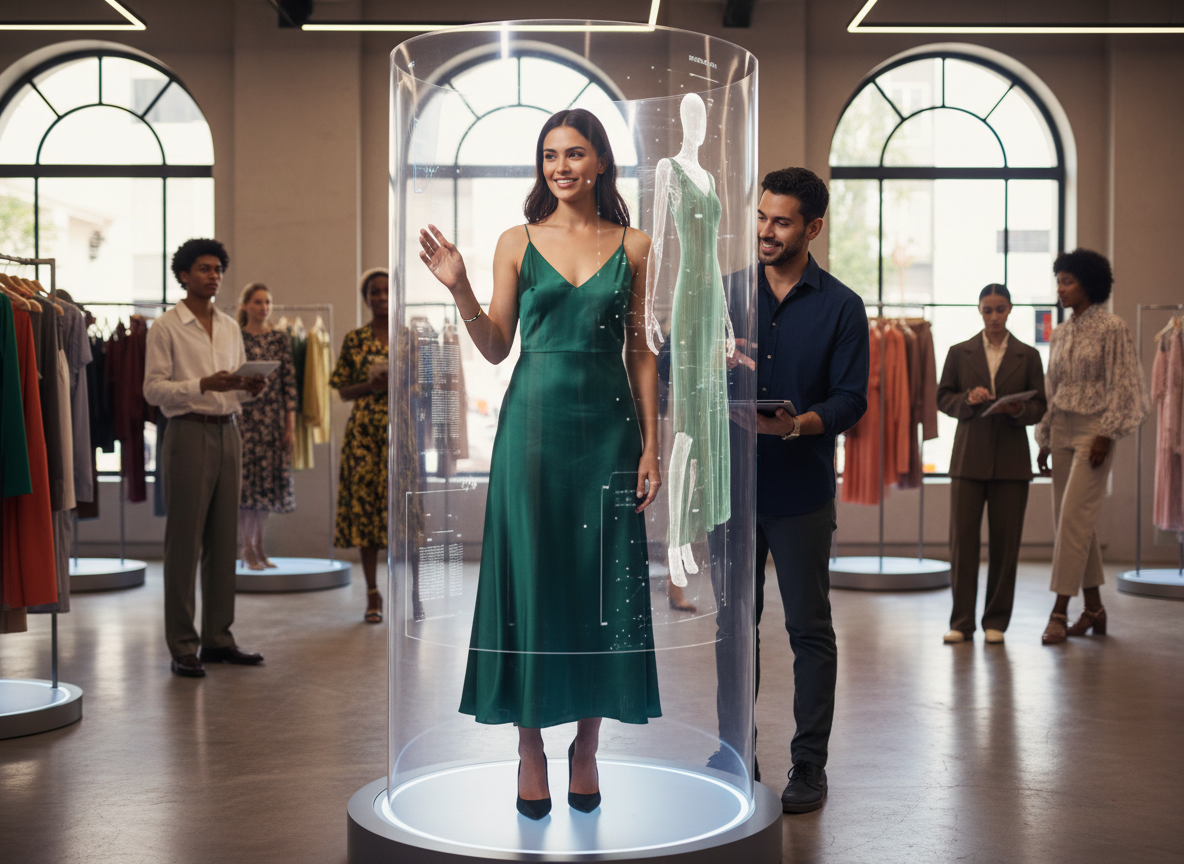
The perennial struggle of online shopping—the 'will it fit?' anxiety—is finally being eradicated in April 2026. This week, several global retail giants have rolled out their 'Gen-AI Fit' modules, a sophisticated blend of generative artificial intelligence and high-fidelity 3D body scanning. This technology allows consumers to create a 1:1 digital twin of their physique using a simple 15-second smartphone scan. The AI then 'virtually wears' every garment in the catalog, providing a real-time visualization of how the fabric drapes, stretches, and moves on the user's specific frame.
What sets the April 2026 update apart from previous iterations is the use of 'Kinetic Mapping.' Earlier versions of virtual fitting rooms were static and often failed to account for how a person moves. The new AI models can predict the tension of a seam during a walk or the way a jacket shoulders will sit when the wearer sits down. This has led to a staggering 75% reduction in return rates for the brands that have piloted the technology over the last ten days, marking a major win for both profitability and sustainability.
Beyond just fit, these AI systems are now acting as hyper-personalized stylists. By analyzing a user's previous purchases, social media activity (with consent), and even the local weather forecast for their city, the AI suggests complete outfits that align with the user's aesthetic and practical needs. For instance, if a user in London has an outdoor meeting scheduled for April 12th, the AI will suggest a waterproof yet breathable ensemble from their current wardrobe and suggest one new piece that would complete the look.
The 'Mirror-Link' ecosystem is another major innovation launched this month. This allows the AI stylist to connect with smart mirrors in physical stores. As a customer walks into a boutique, the mirror recognizes their digital twin profile and pre-loads recommendations onto a tablet in the fitting room. This seamless integration of online data and offline experience is the hallmark of 'Phygital' retail in 2026, offering a level of service that was previously reserved for ultra-wealthy clients of personal shoppers.
Fashion designers are also utilizing this data to create 'Dynamic Sizing' charts. Instead of the traditional Small, Medium, and Large, brands are moving toward a spectrum of measurements that better reflect the diversity of human bodies. The AI collects anonymized data on body shapes and informs the production cycle, ensuring that the proportions of the garments manufactured actually match the population. This data-driven design process is significantly reducing the amount of deadstock that ends up in landfills.
Privacy remains a top priority in this technological shift. The latest 2026 protocols ensure that all biometric data is stored locally on the user's device and is never uploaded to a central server. Only the 'fit compatibility' score is shared with the retailer. This focus on 'Self-Sovereign Identity' has helped overcome consumer hesitance, leading to a massive surge in adoption rates this spring. People are now more willing to trust AI with their measurements when they know they retain full control over the data.
The impact on fast fashion is also profound. Brands are now offering 'On-Demand Customization' where a basic design can be tweaked by the AI to perfectly match a customer's measurements before it is even cut and sewn. This shift toward a 'make-to-order' model is the ultimate goal of the sustainable fashion movement, as it eliminates overproduction entirely. By April 10, 2026, we are seeing the first large-scale factories fully dedicated to this AI-driven personalized production.
As we look forward, the role of the human stylist is evolving rather than disappearing. Professionals are now using these AI tools to manage thousands of clients simultaneously, providing the creative direction and emotional intelligence that the AI lacks, while the technology handles the logistics of fit and availability. The result is a more efficient, inclusive, and satisfying shopping experience that marks a new era for the global fashion economy. The retail landscape of April 2026 is smarter, faster, and infinitely more personal.