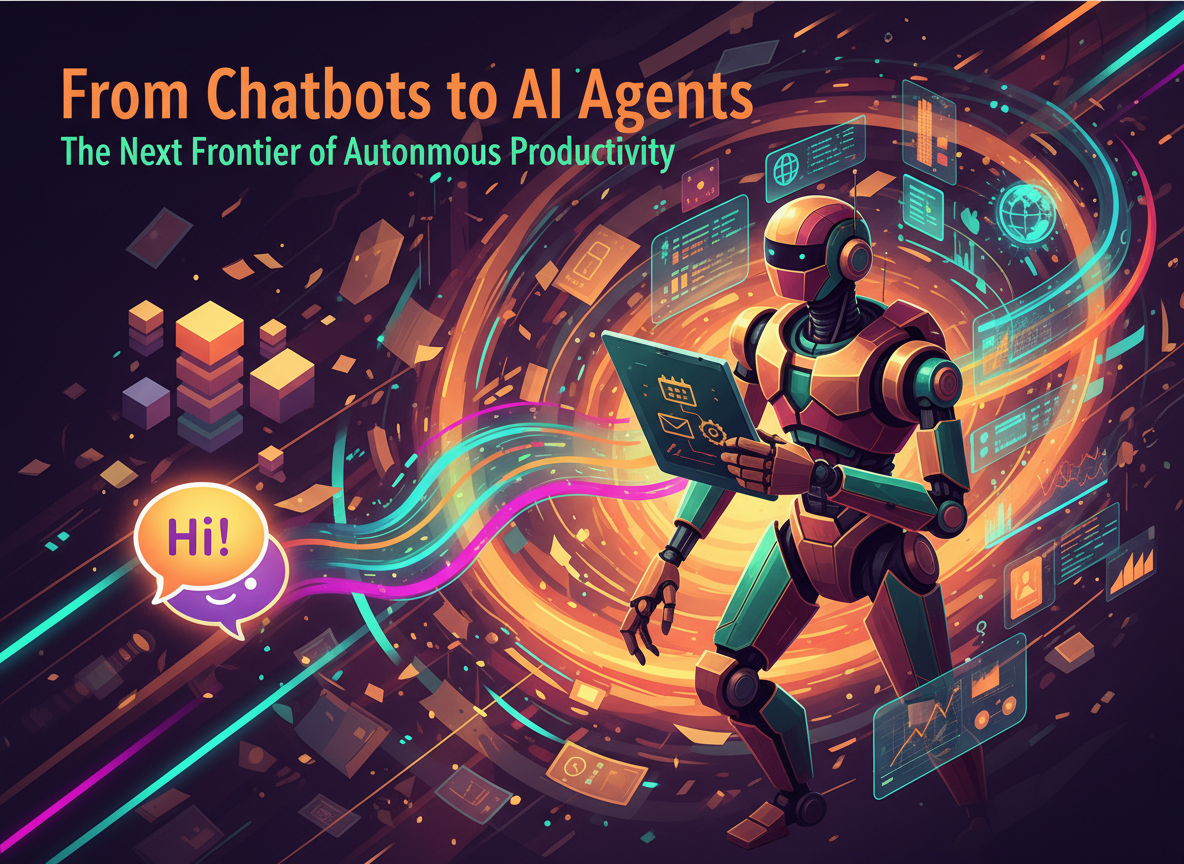
The narrative of artificial intelligence is transitioning from conversational interfaces to proactive, autonomous agents. While the previous year was defined by the 'chatbot'—a reactive system that responds to user prompts—2024 is becoming the year of the 'AI Agent.' These systems are designed to go beyond mere conversation, possessing the ability to plan, use tools, and execute complex workflows with minimal human intervention. This shift represents a move toward goal-oriented AI that can manage its own lifecycle of tasks.
An AI agent differs from a standard Large Language Model (LLM) in its architectural loop. While an LLM generates a single response, an agentic system uses the model as a reasoning engine to decide which actions to take. This involves 'Chain-of-Thought' processing, where the AI breaks a high-level goal into smaller, actionable sub-tasks. By interacting with external software, APIs, and databases, these agents can perform real-world actions like booking flights, managing code repositories, or conducting market research autonomously.
One of the most exciting developments in this space is the rise of multi-agent systems. In these environments, different AI agents with specialized roles—such as a 'Project Manager,' a 'Coder,' and a 'Reviewer'—collaborate to solve a problem. This mimics human organizational structures and allows for higher levels of accuracy through internal peer review and iterative refinement. Frameworks like AutoGPT and Microsoft's AutoGen are paving the way for developers to build these complex collaborative ecosystems.
The shift toward agentic workflows is also changing the way we think about user interfaces. Instead of a 'chat box' where users must figure out the right prompts, the future of software may involve 'invisible' interfaces where the agent anticipates needs based on context. For example, an autonomous agent integrated into an enterprise system could identify a supply chain bottleneck and proactively draft an alternative logistics plan before a human even realizes there is a problem.
Enterprise adoption of AI agents is accelerating as companies look for ways to scale operations without proportional increases in headcount. In sectors like finance and legal, agents are being used to automate document review and compliance checks that previously required thousands of human hours. The ability of these systems to work 24/7 without fatigue, while maintaining a high degree of precision, makes them an attractive proposition for digital transformation.
However, the move toward autonomy introduces new challenges in terms of reliability and safety. If an AI agent is given access to a company's financial accounts or production servers, the cost of an error becomes significantly higher than a simple hallucination in a text summary. Developers are working on 'human-in-the-loop' safeguards and rigorous sandboxing to ensure that agents remain within their intended boundaries and can be audited at every step of their reasoning process.
Another critical aspect of the agentic revolution is the improvement in 'long-term memory.' For an agent to be truly effective, it must remember previous interactions and learn from its successes and failures. Modern architectures are incorporating RAG (Retrieval-Augmented Generation) and vector databases to give agents a persistent memory store. This allows them to develop a deeper understanding of a user's preferences and a company's specific operational nuances over time.
Ultimately, the rise of AI agents marks a fundamental change in our relationship with technology. We are moving from a world where we use tools to a world where we collaborate with partners. As these autonomous systems become more integrated into our daily lives, they will free us from routine administrative tasks, allowing human creativity and strategic thinking to take center stage. The autonomous era is not just about automation; it is about the amplification of human potential.