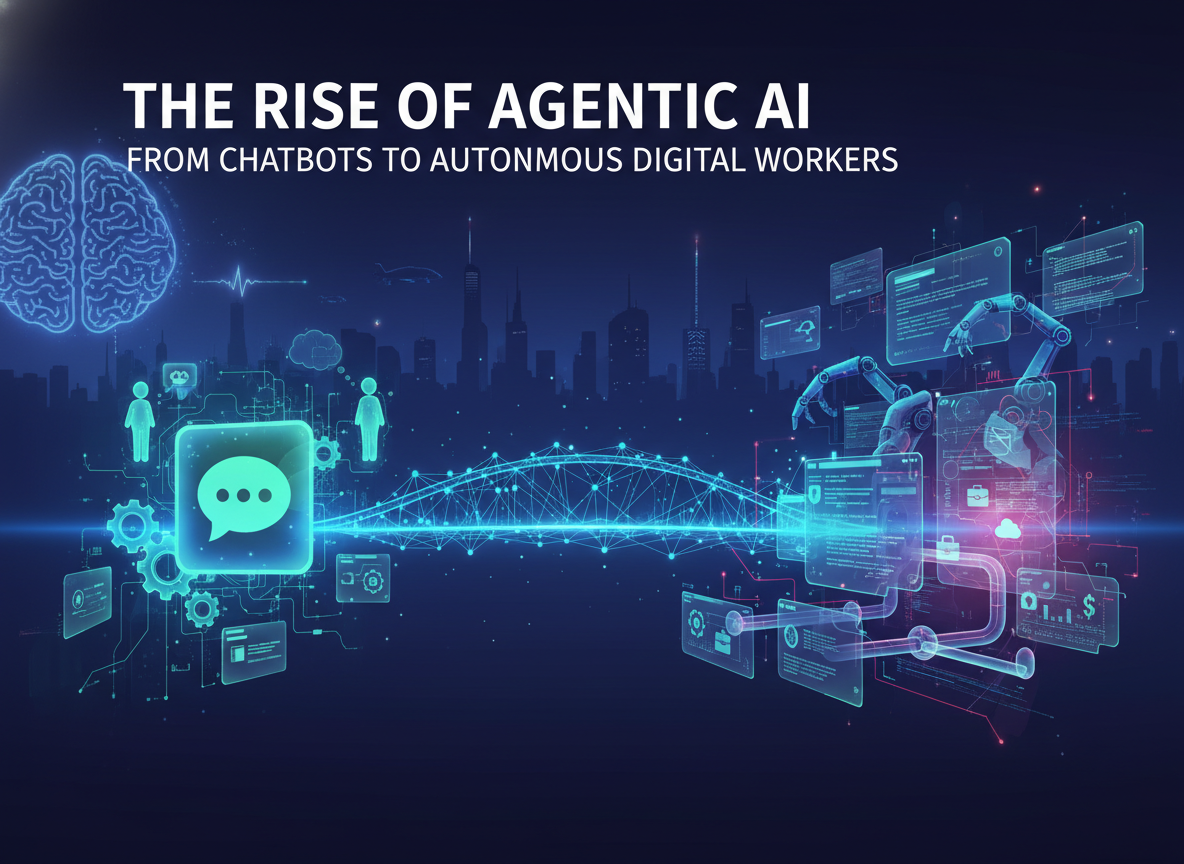
The narrative of artificial intelligence is shifting from 'generative' to 'agentic.' While generative AI focuses on creating content, agentic AI focuses on taking action. An AI agent is a system that can be given a high-level goal—such as 'plan a business trip' or 'build a marketing campaign'—and then independently break that goal down into sub-tasks, use external tools, and see the project through to completion. This transition from passive chatbots to active autonomous workers is set to redefine productivity and the very nature of corporate structures in the coming years.
The key differentiator for agentic systems is their ability to use 'tools' and 'reasoning loops.' Instead of just predicting the next word in a sentence, these models can interact with web browsers, databases, and software APIs. For example, an agentic AI developer can write code, test it, find bugs, and deploy it to a server without a human ever touching the keyboard. This 'self-correction' mechanism, where the AI evaluates its own output and adjusts its strategy based on feedback, is what makes these systems so much more powerful than traditional automation.
Enterprises are particularly excited about the potential for 'Agentic Workflows' to handle customer service and logistics. Imagine a customer support agent that doesn't just answer questions about a missing package but can actually log into the shipping database, track the delay, negotiate a partial refund with the carrier, and email the customer a resolution. This level of autonomy moves AI from a cost center (requiring human oversight) to a value driver that can operate at scale with minimal intervention.
The development of frameworks like AutoGPT and BabyAGI sparked early interest in this space, but the latest enterprise-grade solutions from companies like Salesforce and Microsoft are bringing these concepts to the mainstream. Microsoft's 'Autogen' framework allows multiple AI agents to talk to each other to solve a problem—one might act as a coder, another as a reviewer, and a third as a project manager. This 'multi-agent' orchestration mimics a human team and leads to much more robust and accurate outcomes than a single model working in isolation.
One of the biggest hurdles to widespread adoption is the 'reliability gap.' Autonomous agents can sometimes get stuck in infinite loops or hallucinate incorrect actions that lead to real-world errors. For an agent to be useful, it must have a high degree of dependability. To address this, researchers are developing better 'memory' systems that allow agents to learn from past experiences and 'guardrails' that prevent them from performing unauthorized or dangerous actions. The focus is on creating 'Human-in-the-Loop' systems where the AI handles 95% of the work but flags a human for final approval on critical decisions.
The implications for the labor market are significant and complex. As AI agents become capable of handling routine administrative and technical tasks, the value of human labor will likely shift toward high-level strategy, empathy, and creative oversight. While some fear massive job displacement, others argue that agentic AI will eliminate the 'drudge work' that currently consumes most of our time, allowing people to focus on the work that truly matters. The challenge for society will be managing this transition through reskilling and updated economic policies.
Security is another major concern in the world of autonomous agents. If an AI agent has the power to spend money, access private data, or communicate on behalf of a user, it becomes a high-value target for hackers. 'Prompt injection' attacks, where a malicious actor trick the agent into ignoring its instructions, could lead to catastrophic results. Building 'secure-by-design' agents that can resist manipulation and operate within strict sandbox environments is a top priority for cybersecurity experts in the AI space.
Looking forward, we are moving toward a 'world of agents' where every individual has a fleet of digital assistants managing their life and work. Your personal agent will know your preferences, your schedule, and your goals, acting as a proactive partner rather than a reactive tool. This vision of ubiquitous, autonomous AI is no longer science fiction; it is the current trajectory of the industry. As agents become more integrated into our digital infrastructure, the boundary between software and intelligence will effectively disappear.