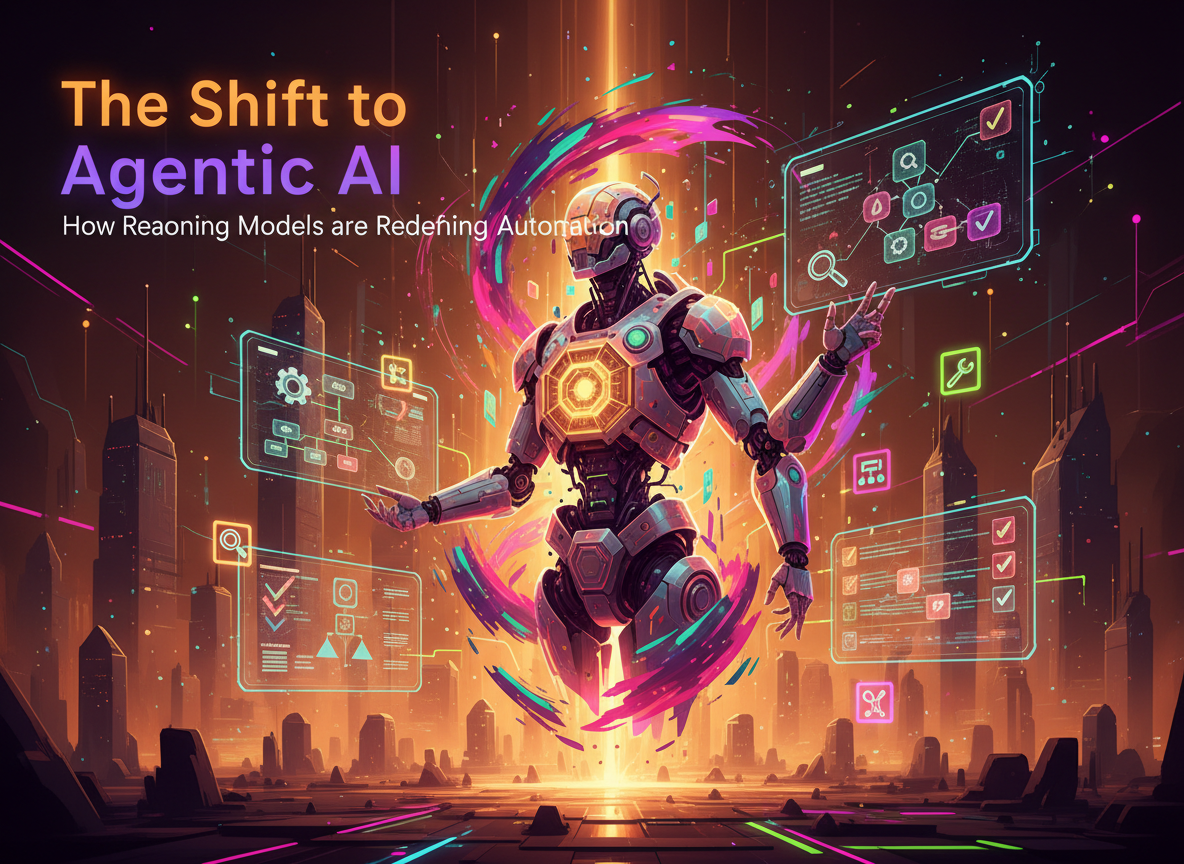
The landscape of artificial intelligence is undergoing a fundamental transformation, moving away from simple predictive text generation toward complex, multi-step reasoning. This evolution, often referred to as the rise of 'Agentic AI,' represents a shift where models no longer just answer questions but actively solve problems by planning and executing sequences of actions. Unlike their predecessors, these new systems use advanced internal processing to evaluate multiple paths before providing a final output.
At the heart of this breakthrough is the implementation of Large Action Models (LAMs) and specialized reasoning architectures like OpenAI's o1 series. These models utilize reinforcement learning and chain-of-thought processing to self-correct during a task. For instance, if an AI agent is tasked with developing a software feature, it can now write code, run tests, identify errors, and refactor the code autonomously until the desired outcome is achieved. This level of self-contained troubleshooting was previously a major hurdle for standard LLMs.
The implications for industries like software engineering, data science, and scientific research are profound. In bioinformatics, agentic systems are being used to simulate protein folding experiments and suggest modifications based on virtual trial-and-error. In the corporate sector, agents are beginning to handle end-to-end workflows such as supply chain logistics and personalized customer journey mapping without human intervention at every step. This move toward 'system 2 thinking'—a psychological term for slow, deliberate cognition—is what sets these models apart.
However, this leap in capability comes with significant challenges, primarily regarding computational overhead and latency. Reasoning models require substantially more compute power per inference compared to standard chat models, as they must 'think' through various scenarios internally. Furthermore, the industry is grappling with new safety concerns: as agents gain more autonomy to interact with external tools and APIs, the risk of unintended consequences increases, necessitating more robust guardrails and alignment techniques.
Looking ahead, the next frontier for Agentic AI is seamless integration into operating systems and hardware. We are entering an era where our devices will not just have assistants we talk to, but agents that work for us in the background. As these models become more efficient and accessible, the boundary between human intent and machine execution will continue to blur, ushering in a new paradigm of human-AI collaboration that prioritizes outcomes over prompts.